
The Queen's Diamond as Symbol
The Three MusketeersThis flow traces the diamond from intimate token to political evidence, financial resource, and emblem of compromised loyalty.
increasing Bearing strength in each event
 decreasing
Bearing strength in each eventdecreasingRoyal Gift
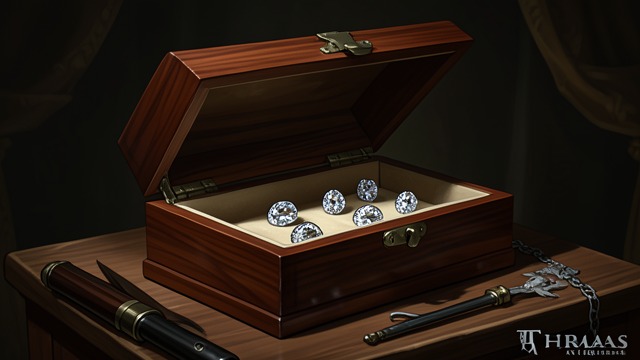
Desire Encased in Wood
Intimate Token
Queen Anne gives Buckingham the rosewood casket containing the diamond studs.
Political Meaning
The object carries emotional memory, but its material value makes private love legible to spies and ministers.
Milady's Theft

The Token Cut Apart
Covert Theft
Milady removes two studs from Buckingham's outfit.
Symbolic Damage
The missing jewels represent the attempt to fracture the relationship between Anne and Buckingham. Their recovery will later restore public appearances without repairing private loss.
D'Artagnan's Transport

A Jewel Crosses Borders
Dangerous Cargo
D'Artagnan carries the restored studs back toward France while enemies search for him.
Burden of Representation
He transports more than stones: the safety of the Queen, Buckingham's honor, and the friends' political future.
Public Display

Proof Before the Court
Visible Completeness
Queen Anne wears all twelve studs before King Louis XIII and Richelieu.
Political Reversal
The object defeats the accusation because public appearance becomes stronger than private suspicion. Ceremony temporarily controls truth.
Diamond Sold

Symbol Becomes Currency
Sacrifice
D'Artagnan sells the Queen's diamond to fund equipment and secret missions.
Changed Meaning
The jewel no longer preserves royal intimacy. It becomes practical capital, showing how political loyalty ultimately consumes its own symbols.
the secret meeting at the Louvre
the Windsor ball eight days before the royal ball
the journey from Paris to London
the Ballet of La Merlaison
after the Bastion Saint-Gervais episode
